 +385 52 501 333
 info@maris.hr


Priključitev na omrežje ali sistem off-grid s soncem in baterijo, z vprašanji in odgovori.
A property without an electricity connection is not a reason to walk away from a purchase, but it is a reason to check more carefully before you commit. You have two options: a connection to the grid of the distribution operator HEP ODS, where the cost depends on the distance to the network, the capacity available in that section of the grid and the connection capacity you need, or a stand-alone off-grid system with solar panels and battery storage. The trap is that you only receive the official connection conditions from HEP during the building permit procedure, in other words once you have already bought the land. Before the purchase, only an informal indication of whether a connection is possible can be obtained, and that is exactly what you should ask for.
Why there are still properties without electricity in Pula and the surrounding area
In our area this is not unusual. It is most often older stone houses in the rural parts of the municipalities, olive groves and agricultural buildings, and plots on the edge of settlements where the grid was simply never built. A separate group are legalised buildings constructed outside residential zones, mostly in woodland and on agricultural land. Around here, most of them are found around Peroj, Barbariga, Kavran and Duga Uvala, and for them a grid connection was often never even planned.
Buyers from abroad run into this more often than locals, because they are precisely the ones looking for peace, views and distance from the village. What looks like an idyll in a photograph can turn into a months-long procedure with HEP if it is not checked in advance.
Your neighbour has electricity, but you might not get it
The most common mistake a buyer makes is the conclusion: the neighbour has electricity, so I will have it too. That is not the same thing. A pole next to the plot means the grid physically exists; it does not mean there is spare capacity in it for a new connection.
We had a client to whom exactly this happened in the very centre of Vodnjan, not in an isolated spot but in a town surrounded on all sides by houses that do have electricity. HEP's answer was that there was not enough capacity in that section of the grid: the transformer station supplying the area had no spare kilowatts, and the solution was to build a new line or upgrade the transformer station, at a cost and on a timescale the buyer cannot influence. The client ended up choosing a system with batteries.
When you actually find out what HEP says
This is the real problem. The official connection conditions from HEP ODS, Elektroistra Pula, can only be requested during the building permit procedure, together with the project. In practice the sequence looks like this: you buy the land, pay the architect and the project, start the building permit procedure, and only then does the answer arrive that the grid in that section is weak, that there are no kilowatts available and a new line needs to be built, or that the transformer station does not have enough capacity. At that point the land is already yours, and the cost of the connection is no longer a matter of price negotiation but of your budget.
Before the purchase there is no official document, but there is information. An informal indication can be obtained from HEP as to whether a connection is possible at all in that section of the grid. It does not bind HEP, but it is enough to tell you whether you are heading into a routine procedure or into a problem. For our clients we carry out this check ourselves, before any negotiation on price even begins. Beyond that, you can reduce the risk yourself:
- look at where the nearest pole, distribution cabinet and transformer station are, and how many houses already depend on them
- ask the neighbours when and how they got their connection, and whether anyone nearby has recently been refused
- the architect who checks whether building is possible checks the infrastructure in the same step, and that is a check you do not skip
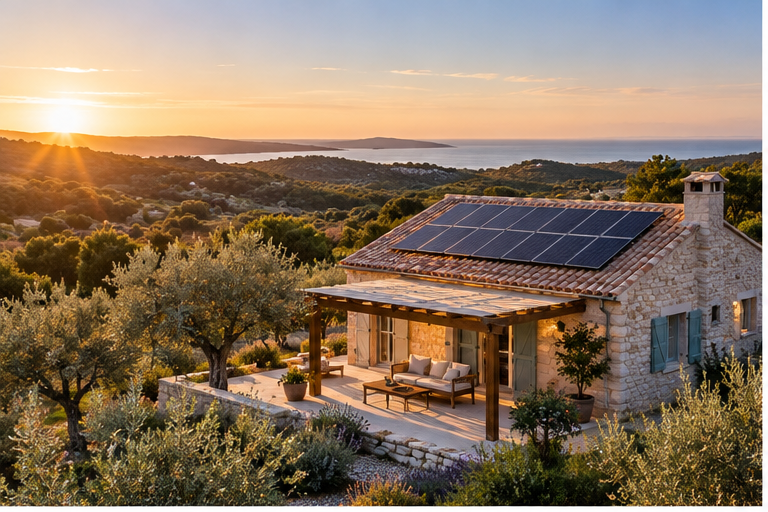
Grid connection: what makes up the cost
If, after checking, you decide on a grid connection, the cost has three parts:
- the connection fee, calculated according to the connection capacity in kilowatts
- the cost of building the connection itself, which rises with the distance from the existing grid
- the cost of upgrading the grid or the transformer station, if there is not enough capacity in that section
The first part is predictable. The other two are not, and as a rule they are borne by whoever requests the connection. If the nearest pole is next to the plot and there is capacity in the grid, it is a routine procedure. If the grid ends a few hundred metres away or the transformer station is at the limit of its capacity, new poles, cables and deadlines you do not control come into play.
The second option: an off-grid system with solar and battery
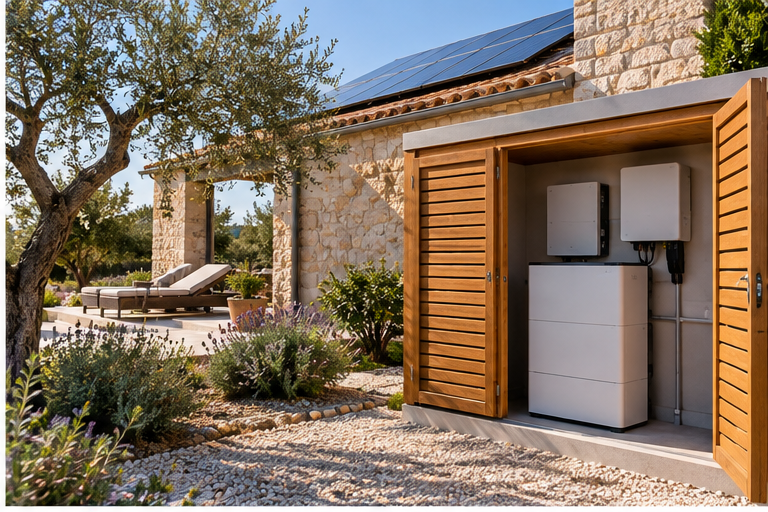
An off-grid system means the building produces and stores its own electricity. Solar panels generate energy during the day, the battery storage keeps the surplus for the evening and night, and a smart inverter manages the whole system. For greater needs or longer periods of cloudy weather, a backup generator is included.
Which properties it suits:
- holiday homes and weekend houses in remote locations
- legalised houses outside residential zones, in woodland and on agricultural land, of which there are most around Peroj, Barbariga, Kavran and Duga Uvala
- olive groves, agricultural buildings and glamping sites
- plots where a connection is too expensive, hard to implement, or where the grid has no capacity, as in the case described in Vodnjan
You have to be realistic: an off-grid system is sized according to consumption. Lighting, a refrigerator, a water pump and the usual appliances are not a problem. Electric heating of the whole house in winter, a pool pump running all day or several air-conditioning units at once require a considerably larger system and a bigger investment. That is why, before deciding, an assessment is made of expected consumption, the space available for panels and the battery capacity needed, with the limitations and the need for backup power clearly stated.
What the spatial plan says
This is the part buyers most often skip. Some spatial plans, especially for buildings outside the construction area, expressly allow an independent energy supply. Others require a solution for connecting to the infrastructure before a house can be built. Before buying land without electricity, this check is done with an architect, together with all the other questions about whether building is possible. We described how this works in practice in the article Building Land Inspection: What You Need to Check Before Buying or Selling.
When you are buying or selling building land
Infrastructure is one of three steps in checking building land: first what may be built, then what infrastructure actually exists, and only then the price. In that step, electricity is most often the surprise, because water and the road can be seen, while capacity in the grid cannot.
Land with no possibility of connection is worth less, and that is a reality the seller has to accept. The buyer factors the cost of the solution and the risk into the price. But in most cases a solution exists, and it is not the most expensive one: solar with battery is today usually the best and cheapest option, especially compared with building a new line or waiting for a transformer station upgrade. A seller who offers, alongside the land, a concrete quote for an off-grid system turns a shortcoming into a settled question and sells from a stronger position.
Take a look at the plots and houses in our portfolio in Pula and the surrounding area.
Free initial assessment for your property
Maris works with Vovčak, a company that designs and installs solar and off-grid systems. If you are considering buying or selling a property without a connection, you can request a free initial assessment of that property's energy options.
Request a free initial assessment
An initial assessment is not an engineering design or a guarantee of uninterrupted supply.
Questions and answers
Why do some older houses in rural areas have no connection to the electricity grid?
Because the grid was never built out to them, and previous owners had neither the need nor the means for a connection. For legalised houses outside residential zones, a connection was often never even planned. Such houses usually have a generator or a small solar system. It is not an obstacle to buying, but it is a fact that must be known before the price is agreed.
My neighbour has electricity, does that mean I will get it too?
Not necessarily. The grid may physically exist without having spare capacity for a new connection. This happened in the very centre of Vodnjan, where HEP replied that the transformer station did not have enough kilowatts. A pole next to the plot is no guarantee of a connection.
Can I find out before buying the land whether I will get a connection?
You only receive HEP's official answer during the building permit procedure, in other words after the purchase. Before the purchase an informal indication can be obtained from HEP as to whether a connection is possible; it does not bind HEP, but it shows what you are dealing with. For our clients we carry out this check, together with an on-site check and the architect's infrastructure check. If the risk is high, factor an off-grid system into the price or the plan straight away.
Does the property have an electricity connection, and how much does connecting cost?
It is one of the first questions we ask the owner. If there is no connection, we request HEP's informal indication of whether a connection is possible and gather everything that can be seen of the grid on site. Nobody can state the exact cost in advance, however, because it depends on the distance to the grid, the connection capacity and whether there is spare capacity in that section of the grid, so we recommend that the buyer allow for a reserve.
Can a house be built on land without electricity?
It depends on the spatial plan and on whether the land is within the construction area. For some locations an independent energy supply is permitted, for others a connection is required. The architect carries out this check before the purchase.
Is an off-grid system enough to live in the house all year round?
It can be, if it is correctly sized for actual consumption and a backup generator is included for the winter periods with little sun. For a house with electric heating and a larger number of appliances, the investment is noticeably higher than for a weekend house used in summer.
Does the lack of a connection affect the price of the land?
Yes, land with no possibility of connection is worth less. But the difference in price is often greater than the actual cost of the solution, because solar with battery is in most cases the cheapest option. A seller who offers a concrete quote for an off-grid system alongside the land reduces that risk in the buyer's eyes and keeps a better negotiating position.
Aljoša Vučetić, prof., licensed real estate agent (licence no. 43/2010), owner of the agency MARIS nekretnine in Pula and president of the Professional Group of Real Estate Brokers of Istria County at the Croatian Chamber of Economy (HGK). He has worked in the Pula real estate market for more than 25 years.
