 +385 52 501 333
 info@maris.hr


How to Buy Real Estate in Istria as a Foreigner: Your Complete 2026 Guide
Istria pulls people in — the coastline, the food, the light. And increasingly, it pulls them in enough to want to stay, or at least to have a place to come back to. A remarkable 37.5% of all property transactions in Croatia are made by international buyers, and Istria consistently attracts the largest share of that demand. Whether you're searching for a coastal villa, an apartment near the sea, or a quiet inland retreat, this guide walks you through what actually happens when a foreigner buys property here — and what to watch out for along the way.
Key Takeaways
| Question | Quick Answer |
|---|---|
| Can EU citizens buy property in Istria? | Yes, EU citizens enjoy the same property rights as Croatian nationals, with no restrictions. |
| Can non-EU citizens buy real estate in Istria? | Yes, with Ministry of Justice approval. Citizens of countries with reciprocal agreements (including the US, UK, and Canada) can purchase freely in most categories. The approval process typically takes around 3 months. |
| What is an OIB and do I need one? | Yes. An OIB (Personal Identification Number) is mandatory for all property transactions in Croatia, and you can obtain it as a foreigner. |
| What are the total buying costs for foreigners? | Expect total closing costs of 6% to 9% of the purchase price, including the 3% real estate transfer tax, legal fees, and agent commission. |
| Do I need a local lawyer? | Strongly recommended. Many reputable agencies work with their own lawyers, and some include legal support within their commission. Always confirm this upfront. |
| What is the best region to buy in Istria? | It depends on your budget and lifestyle. Rovinj and Poreč are premium; Pula and inland areas offer better value. |
| Can I rent out my property as a foreigner? | Yes. Short-term tourist rentals are legal and generate average gross yields of 4% to 6% per year in Istria. |
Can Foreigners Buy Real Estate in Istria? Understanding the Legal Framework
Yes — and the process in 2026 is far more accessible than most buyers expect when they first start asking around. The rules do differ depending on where you're from, so it's worth understanding the framework before you start viewing properties.
EU and EEA citizens face no restrictions at all. Since Croatia joined the EU, buyers from Germany, Austria, the Netherlands, and all other member states have full property rights identical to Croatian nationals.
Non-EU citizens from countries with a reciprocity agreement with Croatia — including the United States, United Kingdom, Canada, and Australia — can also buy freely in most categories. The standard procedure involves obtaining Ministry of Justice approval, which a reputable local real estate agency will walk you through without unnecessary complexity. This approval process typically takes around 3 months, so factor that into your timeline from the start. The full list of countries with reciprocal agreements and the official procedure is published on the Croatian Ministry of Justice website.
One restriction worth knowing upfront: non-EU nationals generally cannot purchase agricultural land for farming purposes without additional approvals. Residential and commercial property, however, is widely accessible.
How to Buy Real Estate in Istria as a Foreigner: The Step-by-Step Roadmap
Knowing the process before you begin saves time, money, and a fair amount of stress. Here's how a typical purchase unfolds in Istria in 2026.
- Define your strategy. Be clear on your budget, preferred region, property type, and intended use — personal residence, holiday home, or rental investment.
- Get your OIB. Your Croatian Personal Identification Number is required for every transaction. You can apply at the local tax authority (Porezna uprava) in person, or through your legal representative.
- Choose a trusted agency. Working with established real estate agencies that specialise in Istria means your interests are protected from day one — not just from the moment you sign something.
- Select a property and conduct due diligence. Check the land register (zemljišna knjiga) and cadastre records, verify the ownership chain, and confirm there are no mortgages or encumbrances on the property.
- Sign a preliminary agreement. This locks in the price and terms. A deposit — typically 10% — is paid at this stage and is held in the agency's escrow account. The full payment to the seller only follows after the main contract is signed and, where applicable, after pre-registration is confirmed.
- Sign the final purchase contract. The contract must be notarised by the seller. Once signed and certified by a notary, we strongly recommend completing a pre-registration in the land registry before transferring funds. Pre-registration is typically visible within one business day and confirms that your ownership claim is recorded — only then should the purchase price be transferred to the seller's account. This step adds an important layer of security that many buyers aren't aware of.
- Register ownership. Your lawyer or notary submits the title transfer to the land registry. This is the final, legally binding step — and the one that truly matters.
For a full breakdown of every milestone, our Buyers' Roadmap covers the entire process in detail, from initial strategy through to post-purchase registration.
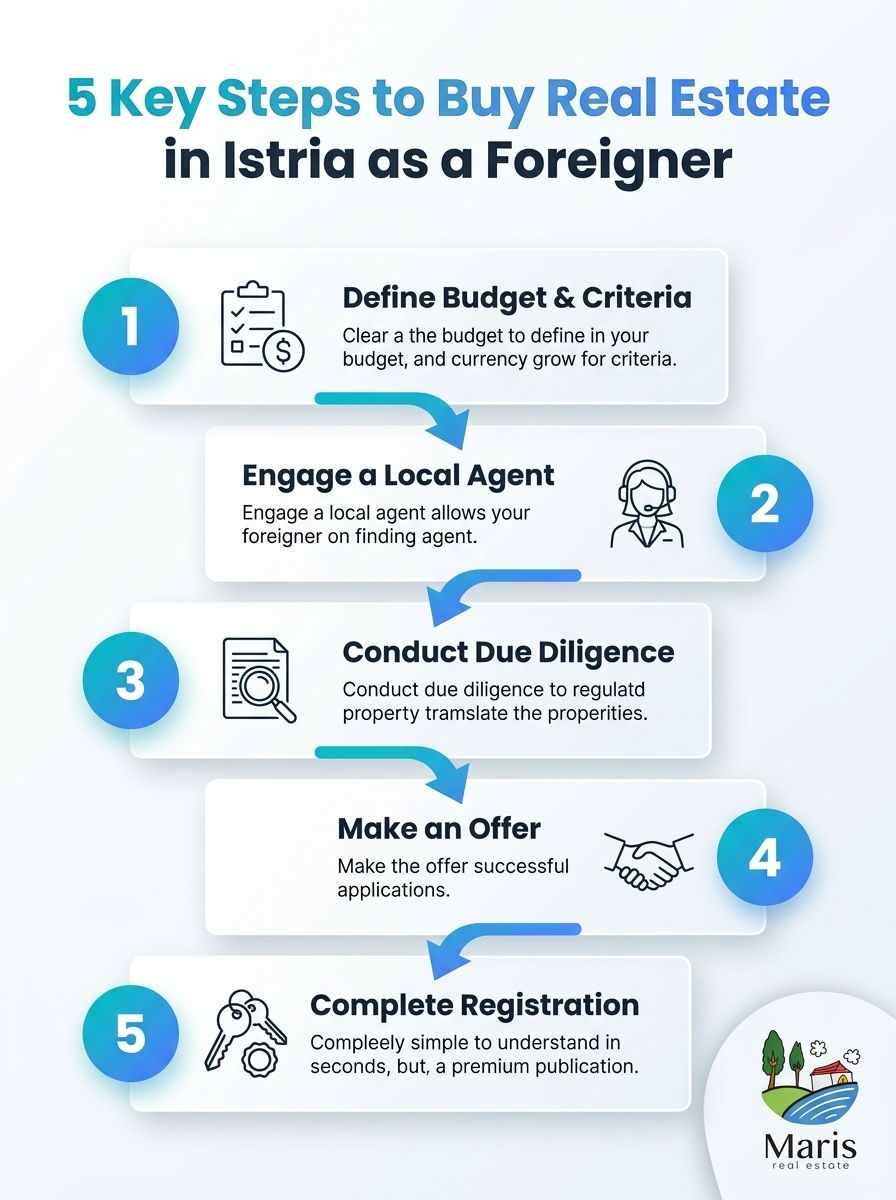
This infographic outlines the five essential steps to buying real estate in Istria as a foreigner, with legal tips.
Understanding the Costs: Budgeting for Property in Istria
One of the most common surprises for foreign buyers is the total cost beyond the listed price. In Istria, closing costs typically run between 6% and 9% of the purchase price — and planning for this from the start makes the whole process far smoother.
| Cost Item | Typical Amount |
|---|---|
| Real Estate Transfer Tax | 3% of purchase price |
| Legal / Notary Fees | 1% to 2% |
| Agency Commission | 2% to 3% |
| Land Registry Fees | Minor administrative cost |
| Annual Property Tax (from 2025) | €0.60 to €8.00 per m², depending on municipality |
The annual property tax is worth paying close attention to. From January 2025, the old holiday home tax was replaced by a new system based on square meters and location. If you're buying property in popular coastal areas, expect to land at the higher end of that range.
Did You Know? 15% of properties in Croatia have mismatches between the land register and cadastre records, making due diligence essential for every foreign buyer. Source: investropa.com
Due Diligence: The Most Important Step When Buying Property in Istria as a Foreigner
If there's one thing we'd want every foreign buyer to hear before they start: don't rush due diligence. It is the foundation of every safe property purchase, and it's where having the right team around you makes the real difference.
In Istria, the issues that come up most often during due diligence include:
- Land register and cadastre mismatches. A significant share of properties carry administrative discrepancies between official records. These can delay — or in some cases block — a transaction if they're not caught early.
- Unregistered construction. Older properties sometimes include extensions or outbuildings that were never legally registered. This needs to be resolved before any contract is signed.
- Outstanding mortgages or liens. A full land registry search confirms whether the property carries any encumbrances.
- Inheritance disputes. Co-ownership and unresolved inheritance cases are not uncommon in Croatia, particularly with older village properties.
We carry out full due diligence checks on every property we represent, so you have peace of mind before a single document is signed. Our Buyers' FAQ also covers the most common questions we receive from international clients about documentation and legal checks.
Working with Real Estate Agencies in Istria: Why Local Expertise Matters
Buying property in a foreign country without local support is one of the most avoidable risks a buyer can take. Croatia has its own legal framework, its own administrative systems, and a local market that rewards experience and penalises assumptions.
Good real estate agencies in Istria do far more than show you properties. They manage the entire process — from the first viewing through to the moment your name appears on the land registry. That means coordinating with lawyers and notaries, handling your OIB application, overseeing due diligence, and managing communication with sellers throughout.
But the process doesn't end at closing. Post-purchase support matters just as much. Utility transfers, tourist rental registration, property management connections, tax obligations — a good agency stays engaged after the keys are handed over, not just until the commission is collected.
At Maris Real Estate, we've built a team that knows this market deeply, speaks your language, and is focused entirely on protecting your interests at every step — before, during, and after the purchase.
A question we hear often: do I need both an agency and a lawyer? Many reputable agencies work closely with their own legal teams, and some include legal support as part of their service. Always confirm what's covered in the commission before you start. What matters most is that you have independent legal oversight — whoever provides it.
Best Regions in Istria to Buy Property as a Foreign Buyer
Istria isn't a single market. Prices, property types, and buyer profiles vary significantly from one region to the next — and understanding where to look is one of the most valuable things a local agency can share with buyers who are new to this market.
- Rovinj Region: The most prestigious address in Istria, with average asking prices reaching €4,756/m² in 2026. The right choice for luxury buyers who want the full Istrian experience.
- Poreč Region: Popular with families and rental investors, thanks to wide beaches, marinas, and well-established tourism infrastructure.
- Pula Region: Offers the broadest price range of any Istrian city — and generally more competitive prices than the northern coast. From entry-level apartments to luxury villas with sea views, Pula is one of the best value options for foreign buyers in 2026.
- Umag Region: Close to the Slovenian border, with strong demand from Slovenian and Italian buyers. Competitive prices for the north-west coast.
- Central Istria: Inland villages and hill towns offer exceptional value, with entry prices as low as €1,500 to €2,500 per square meter — ideal for buyers who want more space for their budget.
- Northern Istria: A quieter, greener part of the peninsula with growing interest from buyers who value privacy and authenticity over proximity to the coast.
We cover all these areas and can help you weigh up the options based on your specific priorities.
How to Buy Real Estate in Istria as a Foreigner: Property Types and Current Listings
Understanding what's available across different budgets helps you enter the market with realistic expectations. Here are some representative properties currently listed in Istria in 2026.
Apartments
A quiet two-bedroom apartment with balcony and garage in Ližnjan, near Medulin, is available at €210,000. With 72 m² of living space, a private garage, and a parking space, it's comfortable coastal living at a sensible price point.
Family Houses
For buyers looking for more space, a modern family home with a heated pool in Pomer is listed at €550,000. The property offers 291 m² of living space, five bedrooms, and an 834 m² plot in a quiet coastal village near Medulin.
Investment Properties
For buyers focused on rental income, a house with 4 apartments and a pool in Medulin — approximately 350 m from the sea — is available at €495,000. Eight bedrooms across four units, three parking spaces, and a layout that's built for the tourist rental market.
Luxury Villas
At the premium end of the market, a villa with character offering luxury, sea views, and peace is listed at €1,300,000. This 315 m² property sits on 1,836 m² of land, with six bedrooms, three bathrooms, and a garage.
Land
For buyers who want to build from scratch, we offer a range of land options. Panoramic sea-view building land in Peroj comes with approved plans for two houses. Building land in Barbariga (521 m²) already has a permit in place for a one-story home — saving considerable time and administration.
Browse the full range of houses for sale, apartments for sale, and land for sale across all Istrian regions.
Financing Your Purchase: What Foreign Buyers Need to Know in 2026
Most international buyers purchase property in Istria with cash — and there's a practical reason for that. While mortgage financing is technically available through Croatian banks, non-EU buyers in particular will find it very difficult to obtain. In most cases, banks require at least 50% of the purchase price to come from your own funds, and even then, approval is far from guaranteed. EU citizens generally have better access, but the process still involves significant documentation.
A few things worth keeping in mind:
- Croatian banks typically finance up to 70% of the property value for eligible buyers.
- Proof of income from your home country is required, and documentation often needs to be translated and certified.
- Interest rates in Croatia have moderated in 2026, but they vary across lenders — comparison is worth the effort.
- Many buyers from Germany and Austria choose to finance their property purchase in Istria through home-country financing secured against existing assets. This is often more straightforward than arranging a Croatian mortgage from scratch.
We can connect you with trusted financial advisers who work regularly with foreign buyers in Istria and understand the cross-border complexities involved.
Did You Know? Gross rental yields for short-term tourist rentals in Istria average between 4% and 6% per year, making it one of the stronger performing coastal rental markets in the Adriatic. Source: jarniascyril.com
Legal Documents Required to Buy Real Estate in Istria as a Foreigner
Having your paperwork ready speeds up the process and shows sellers you're a serious buyer. Here's what you'll typically need as a foreign purchaser in Istria:
- Valid passport or national ID card. Required at all stages of the process.
- OIB (Personal Identification Number). Your Croatian tax identifier. Without it, no transaction can proceed.
- Proof of funds or mortgage pre-approval. Not always legally required, but expected by sellers — and worth having ready.
- Proof of address from your home country. Required for the OIB application and often for the preliminary agreement.
- For non-EU citizens: Ministry of Justice reciprocity confirmation. Your lawyer handles this, but factor the 3-month timeline into your planning.
Requirements can vary slightly depending on whether you're purchasing as an individual or through a company structure. Some buyers choose to purchase through a Croatian company (d.o.o.), which can carry tax advantages in certain circumstances — your lawyer should advise you on the most appropriate structure for your situation.
For more detailed answers, our Buyers' FAQ page covers the most common queries we receive about paperwork, residency implications, and purchasing restrictions.
What Happens After You Buy: Registration, Ongoing Costs, and Rental Income
Land Registry Registration
Once the final contract is signed and the purchase price is paid, your lawyer submits the title transfer to the Croatian land registry. This is what makes your ownership legally recognised and publicly recorded. Don't delay it.
As we tell every client: what truly matters at the end of the process is secure, legally recognised property ownership. Everything else is a means to that end.
Annual Property Tax
From January 2025, Croatia applies an annual property tax of €0.60 to €8.00 per square meter, depending on the municipality and property classification. Coastal municipalities in Istria tend to sit at the higher end of that range. Your municipality will notify you of the applicable rate after ownership registration.
Short-Term Rental Registration
If you plan to rent your property to tourists, you'll need to register as a landlord with the Croatian Ministry of Tourism and pay the applicable tourist taxes. The process is well-established and our team can point you toward the right contacts. With gross yields averaging 4% to 6%, buying property in Istria as a rental investment remains an attractive option in 2026.
Utility Setup and Property Management
Utility connections — electricity, water, internet — transfer to your name after ownership registration. If you won't be in Croatia year-round, a local property management service can handle rental bookings, maintenance, and everything in between.
Common Mistakes Foreign Buyers Make (and How to Avoid Them)
After years of helping international buyers purchase property in Istria, we've seen the same mistakes come up again and again. Here are the ones worth knowing before you start.
- Skipping due diligence to speed things up. The time you think you're saving isn't worth the risk. Title and cadastre checks exist for very good reason.
- Budgeting only for the listed price. Always add 6% to 9% on top. The taxes, fees, and commissions are real and unavoidable.
- Choosing the wrong legal representative. Your lawyer must be independent from the seller. Never use a lawyer recommended by the selling party without verifying their independence first.
- Underestimating language barriers. All official documents in Croatia are in Croatian. Bilingual legal support isn't a nice-to-have — it's essential.
- Not understanding how most agencies operate. The majority of real estate agencies in Croatia work on an open listing basis — meaning the same property is listed with multiple agencies simultaneously. As a result, many listings deliberately hide key information: the exact location, exterior photos, or the full address. You'll also notice the same property appearing at different prices across different agencies. This isn't a mistake — it's a consequence of a market where agencies fear being bypassed by buyers who find the property independently. Our strong recommendation: look for agencies that work on an exclusive representation basis. With exclusive listings, you get complete information — address, full photo sets, accurate pricing, and direct access to verified data. It simply makes the whole process more transparent.
- Not considering a buyer's agent. Given how fragmented the market is, one of the smartest moves a foreign buyer can make is to engage a dedicated buyer's agent — someone who works exclusively for you, not the seller. This service is typically paid on a monthly retainer basis, and in our experience, it pays for itself many times over in time saved, mistakes avoided, and better deals negotiated.
- Ignoring the full lifecycle cost. Seafront property can carry a 60% price premium over comparable inland properties. Factor ongoing costs into your decision, not just the purchase price.
A browse through our regional pages is a good starting point for understanding what each part of Istria genuinely offers before you even book a viewing.
Questions from American and Non-EU Buyers: Real Answers
If you're a non-EU buyer — particularly from the United States — you likely have very specific questions about how the purchase process works for someone in your situation. We recently participated in a panel discussion at ACAP where exactly these questions came up: reciprocity approvals, financing constraints, tax implications, and what the process actually looks like end to end. You can read the full discussion and the most frequently asked questions from American buyers here: Croatian Real Estate Market — What Buyers Want, How to Obtain Properties, Where the Market Is Headed.
Conclusion: How to Buy Real Estate in Istria as a Foreigner, Done Right
Buying property in Istria as a foreigner is absolutely achievable — and for buyers who come prepared, it tends to be a smoother experience than they expected. The market in 2026 offers a compelling mix of lifestyle, investment potential, and long-term value, whether you're after a coastal apartment, a family villa, or a hillside retreat in central Istria.
The fundamentals are simple: get your OIB sorted early, work with a real estate agency that genuinely knows this market, hire an independent lawyer, budget for the full acquisition cost, and never cut corners on due diligence. Buyers from abroad consistently tell us that having one reliable point of contact made the whole process far less daunting than they'd imagined.
Whether you're just beginning to explore or ready to make an offer, we're here. Contact us and let's make your Istrian property purchase safe, transparent, and straightforward from start to finish.
Frequently Asked Questions
Do I need to be present in Croatia to sign the purchase contract? No. The buyer does not need to be physically present at the notary for the contract signing. In Croatia, only the seller notarises their signature. The buyer can simply sign the contract and send a scanned copy via email — that is legally sufficient to complete this step. Alternatively, you can authorise a legal representative via power of attorney to act on your behalf. Either way, the process is designed to be practical for international buyers who cannot travel to Croatia for every stage of the transaction.
How long does the land registry process take after purchase? It depends on your citizenship. EU citizens can expect ownership registration to be completed within one to two business days after the final contract is signed. Non-EU citizens face a longer wait — the Ministry of Justice reciprocity approval must be obtained first, which typically takes around 3 months. During this period, a pre-registration in the land registry protects your ownership claim while the approval is processed.
Who handles the transfer of utilities after purchase? In most cases, the buyer's agency manages the utility transfer process — electricity, water, and other services. This is part of the post-purchase support a good agency provides. In practice, the process can take one to two months to complete fully, so plan accordingly if you intend to use or rent the property immediately after closing.
Do I need to be in Croatia for the entire buying process? No. Many international buyers complete the majority of the process remotely, visiting Croatia only for viewings. A trusted agency and legal representative can manage documentation, communication with sellers, and administrative steps on your behalf.
What is an OIB and how do I get one? An OIB (Osobni identifikacijski broj) is your Croatian Personal Identification Number — mandatory for every property transaction. You can obtain it at the local tax authority (Porezna uprava) in person, or through your legal representative without needing to be present yourself.
Can I rent out my property as a foreign owner? Yes. Short-term tourist rentals are fully legal for foreign property owners in Croatia. You'll need to register as a landlord with the Croatian Ministry of Tourism and pay the applicable tourist taxes. Gross rental yields in Istria average between 4% and 6% per year, making it one of the more attractive rental markets on the Adriatic.
Is it safe to buy property in Istria as a foreigner? Yes — provided you work with the right team. The key protections are: thorough due diligence before signing anything, an independent lawyer verifying the title, pre-registration in the land registry before transferring funds, and an experienced local agency managing the process end to end. With those in place, the transaction is well-protected at every stage.
How do I find reliable property listings in Istria? Be aware that most agencies in Croatia operate on an open listing basis — the same property appears across multiple agencies, often with different prices and incomplete information. For verified, transparent listings with full location details and accurate pricing, look for agencies that work on an exclusive representation basis. You can explore our verified listings across all Istrian regions at maris.hr.
Author: Aljoša Vučetić
