 +385 52 501 333
 info@maris.hr


Buying Property in Istria Legal Guide: Everything You Need Before You Sign
If you are reading this buying property in Istria legal guide, here is a number that surprises almost everyone. According to Croatian National Bank housing market data, only about 14.8% of residential property purchases in Istria County are financed through housing loans, which means more than 85% of transactions are completed without a traditional mortgage. That single fact tells you more about this market than any brochure ever could, and it shapes every legal step we are about to walk through together.
I want freedom. Those were the first words I said to my wife before my bags even hit the ground after a business trip years ago. And freedom, for so many of the buyers we meet, looks like a stone house on a red Istrian hill, the sea somewhere in the distance, and the quiet certainty that the paperwork is clean.
So let us be honest, the way we always try to be. The dream is the easy part. The law is where people get nervous. This guide exists to take that nervousness away, one step at a time, whether you found us searching for lands, apartments or houses for sale in Istria. It combines Croatian legislation with practical lessons from more than 25 years of property transactions in and around Pula.
Key Takeaways
|
Question |
Short Answer |
|
Can foreigners legally buy property in Istria? |
Yes. EU citizens buy on equal terms with Croatians. Non-EU buyers can also purchase, often through reciprocity or a simple company structure. See our complete 2026 foreigner's guide. |
|
What is the first legal step? |
Verifying that the land registry (zemljišne knjige) and the cadastre match before you pay a cent. Walk the full buyer's roadmap. |
|
How much tax do I pay? |
Real estate transfer tax is 3% of the purchase price for most resale properties. |
|
Do I need a lawyer or a notary? |
Both. A lawyer reviews the contract, a public notary verifies signatures. Never skip either. |
|
How do I know the price is fair? |
Compare against the regional average per square metre and ask your agent for recent local sales. Our buyer's FAQ covers the details. |
Why a Buying Property in Istria Legal Guide Matters More Than the View
Let's be honest, numbers don't lie. The most beautiful stone house in the world is worth very little if the title is tangled.
We have seen it. A buyer falls in love with the olive trees, the dry-stone walls, the smell of the maquis after rain. Then the land registry reveals four heirs, one of whom lives abroad and has not signed anything since the 1990s. Sometimes permits are missing. Sometimes the house on the ground does not match the official records.
This is exactly why a proper buying property in Istria legal guide starts not with the property, but with the paper trail behind it. The view sells the house. The documents let you keep it.
Istria is small. The systems are large, but the people are larger, and that is where local knowledge becomes priceless. "To je mali od Toneta," a neighbour will say, and suddenly the architect, the surveyor, and the previous owner's cousin are all part of the same conversation.

A concise visual guide to the five essential legal steps for buying property in Istria.
Step One: Land Registry and Cadastre, the Twin Pillars
Every honest buying property in Istria legal guide begins in the same place. The zemljišne knjige (land registry) and the katastar (cadastre).
The land registry tells you who legally owns the property and what burdens sit on it: mortgages, easements, rights of way, liens, and court annotations. The cadastre describes the physical reality, the boundaries, the surface area, and the building outline.
Here is the catch, and we say it plainly because hiding flaws is not how we work. In older Istrian villages, these two records do not always agree.
A stone house standing for two hundred years may not appear correctly in the cadastre. A plot listed as 545 m² may have a different shape on the ground. Before any deposit changes hands, both records must be reconciled. This is the foundation of the entire process and the part where a good agent and a sharp lawyer earn their keep.
The Most Common Legal Issues We Encounter in Istria
After more than 25 years of following property transactions throughout Istria, one thing makes us optimistic. Legal documentation is significantly better today than it was twenty years ago. Ownership disputes and inheritance problems are far less common than they used to be.
That said, several issues still appear regularly during due diligence. Today they relate mostly to permits, registrations, and technical documentation rather than ownership itself: missing use permits, unregistered extensions, a building footprint that does not match the cadastre, or an access road that is not formally registered. None of these is fatal, but each one needs to be found and resolved before you pay.
|
Issue |
Frequency |
|
Missing use permit |
62% |
|
Illegal extensions |
20% |
|
Lack of registered access roads |
10% |
|
Registry/cadastre mismatch |
3% |
|
Hidden encumbrances and active seals |
2% |
|
Lack of spousal consent |
2% |
|
Unresolved inheritance |
1% |
|
Maritime domain restrictions |
<1% |
Interestingly, more than 80% of the issues we encounter today relate to missing permits and unregistered alterations rather than ownership disputes, a significant improvement compared to the market 20 years ago.
Step Two: Building Land, Agricultural Land, and the Question That Costs Thousands
Is the land actually buildable? You would be amazed how often the romantic answer and the legal answer differ.
In Croatia, a parcel can be classified as građevinsko zemljište (building land), poljoprivredno zemljište (agricultural land), or a mix of both. That distinction decides whether you build your dream or plant olives and wait. Building land near the sea carries a premium. Consider these real examples from our current land listings:
- Medulin (Biškupija): 545 m² fenced building plot, 700 m from the sea, full infrastructure connected on the plot, sold by auction with a starting price of €159,000. See the full listing.
- Peroj (near Fažana): ready-to-build residential plots minutes from the sea, complete with infrastructure, in one of southern Istria's most sought-after villages.
- Ližnjan / Medulin: building land with a partly agricultural designation, ideal for a custom build away from the tourist crowds.
Before you sign for any of these, your legal guide checklist includes the spatial plan (prostorni plan) of the municipality. It confirms what you may build, how high, how far from the boundary, and the maximum building coefficient. Skipping this step is the single most expensive mistake we see.
For a detailed breakdown of everything you need to know about building land, you can watch my video guide here: 11 things you need to know before buying land in Croatia.
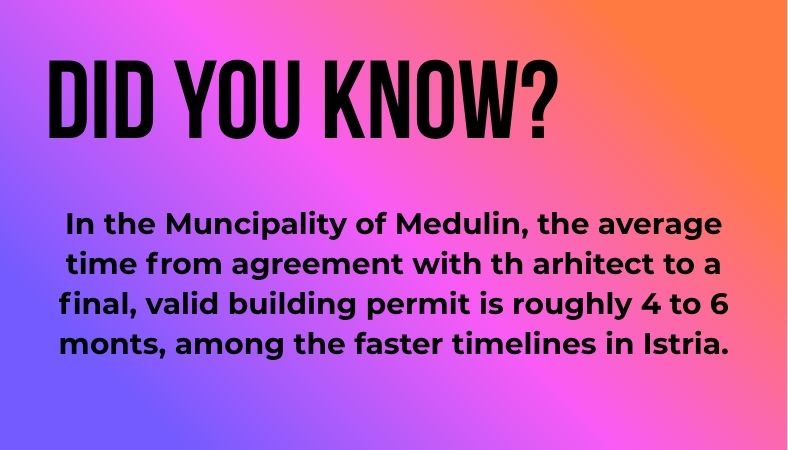
Source: Maris Nekretnine, based on local transaction experience.
Step Three: The Preliminary Contract and the Deposit
Once the records are clean and the land is what it claims to be, you reach the predugovor, the preliminary contract. This agreement binds both sides and typically sets out the purchase price, the exact property identification, the payment schedule, the handover date, and the deposit amount.
The deposit (kapara) is commonly around 10% of the purchase price. If the buyer walks away without legal justification, the deposit is usually forfeited. If the seller walks away, they typically return double.
This is not a formality you rush. A lawyer must read every clause before you sign. The preliminary contract should name the exact parcel, the agreed price, the payment schedule, and the date the property is handed over free of any third-party rights. Transparency here is not a risk. It is the most powerful protection you have.
Step Four: The Main Contract, the Notary, and Tabular Consent
The kupoprodajni ugovor (final sales contract) is where ownership genuinely moves. Two things make it legally complete in Croatia.
First, the seller signs a clausula intabulandi, the tabular consent allowing your name to be entered into the land registry. Second, a public notary (javni bilježnik) verifies the signatures.
Only after the full price is paid and the notary has done their work do you submit everything to the land registry court. Registration can take weeks or months, but legally you are protected from the moment the application is officially filed.
And the tax? Plan for the 3% real estate transfer tax on most resale properties, payable after the contract is registered. Newly built properties sold by a VAT-registered developer follow different rules, so confirm which applies to your purchase.
Financing: When Cash Is King and When It Is Not
Remember that opening statistic. According to Croatian National Bank housing market data, only about 14.8% of residential purchases in Istria County are financed through housing loans, which makes Istria one of Croatia's most cash-driven property markets. That changes the legal and practical landscape entirely.
If you are a cash buyer, you tend to negotiate more effectively, complete transactions faster, and face fewer delays. If you need a mortgage, you are competing in a market where sellers prefer the certainty of cash, so your financing must be approved and watertight before you make an offer.
When budgeting, plan realistically for the 10% deposit, the 3% transfer tax, lawyer and notary fees, agency fees, and renovation costs where applicable. Our pricing page sets out our agency costs with no surprises.
Source: Croatian National Bank, Residential Real Estate Market Analysis.
Property Buying Legal Checklist for Istria
Before starting your search, follow our Buyer’s Roadmap
Before paying any deposit, verify the following:
- Land registry extract
- Cadastral plan
- Ownership verification
- Active encumbrances or annotations
- Building permit
- Use permit (uporabna dozvola)
- Spatial plan classification
- Registered access road
- Utility infrastructure
- Spousal consent (where applicable)
- Contract review by a lawyer
- Notary verification
- Land registry registration
What You Can Actually Buy: Houses, Apartments, and Land
The legal steps stay the same, but the property type shapes the checks you run. Here is how the three main categories compare in today's market.
|
Property Type |
Example |
Key Legal Check |
|
Family house near Kamenjak Nature Park, Medulin |
Use permit (uporabna dozvola) and legality of every extension |
|
|
Two-bedroom apartment with sea view over Pula's rooftops |
Clear floor-plan ownership (etažiranje) and shared-cost agreements |
|
|
Building plot in Medulin, 545 m², 700 m from the sea |
Spatial plan classification and utility connections |
If you are still deciding where in southern Istria to settle, the personality of each place matters as much as the law. Pula and its surroundings mix city life with coastline, from the quiet residential streets of Medulin and Ližnjan to the stone villages of Peroj and Vodnjan.
Working With Real Estate Agencies : Why the Right Partner Changes Everything
You will find dozens of real estate agencies in Istria. Big systems have big numbers, but small systems have the irreplaceable thing, people.
We made a choice years ago not to grow into a giant agency. Not because we could not, but because the moment you do, the personal touch evaporates. The neighbour who knows the architect. The phone call that confirms a boundary in an afternoon instead of a month.
A professional agent coordinates the documentation checks, the lawyer, the notary, the surveyor, and the municipal offices, and tells you honestly when a property is not worth buying. That honesty often saves more money than any negotiation. If you want help locating the right home before the paperwork even begins, our property searching service exists for exactly that reason.
The Foreigner's Path: A Note for International Buyers
EU citizens buy under the same rules as Croatian nationals. Non-EU buyers face an extra layer, either reciprocity agreements or a Croatian company that holds the property, and both routes are entirely legal when handled properly.
The key is to understand your status before you fall in love with a house. Our breakdown of the purchasing process for foreigners explains the documents, the timeline, and the small details that trip people up.
Conclusion
A buying property in Istria legal guide is not meant to scare you. It is meant to set you free, free to enjoy the stone, the sea, and the red hills without a single doubt about the paper underneath them.
The key is simple. Verify the land registry. Verify the cadastre. Confirm the permits. Read the contract carefully. Choose people who treat your purchase as a responsibility rather than a transaction.
The dream of owning property in Istria is real, and so is the protection that makes it last.
Whether you are searching for a stone house in Medulin, an apartment in Pula, a villa near Rovinj, or building land in southern Istria, the right due diligence today can save years of problems tomorrow.
When you are ready to take the first step, browse our full selection of Istrian real estate and let us walk the legal road beside you, from the first viewing to the day the keys are truly yours.
Frequently Asked Questions
Can a foreigner buy property in Istria in 2026?
Yes. EU citizens buy on the same terms as Croatians, and non-EU buyers can purchase through reciprocity agreements or a Croatian company. The legal steps remain the same, with one extra status check for non-EU buyers.
How much are the total costs and taxes when buying property in Istria?
Budget for the 3% real estate transfer tax on most resale properties, plus lawyer and notary fees and your agency commission. A 10% deposit is standard at the preliminary contract stage, and finance buyers should secure approval before making an offer.
Do I really need a lawyer to buy property in Istria?
Absolutely. A lawyer checks the land registry, the cadastre, and every clause of the contract, while a public notary verifies the signatures. Skipping legal review is the most common and most costly mistake we see among first-time buyers.
What is the biggest legal risk when buying property in Istria?
The biggest risk is purchasing without verifying ownership records, permits, and cadastral documentation. Missing use permits and unregistered alterations remain among the most common issues found during due diligence.
What is the difference between building land and agricultural land in Istria?
Building land (građevinsko zemljište) lets you legally construct a home, while agricultural land does not. Many Istrian plots are split between the two, so always confirm the municipal spatial plan before buying.
How long does the property buying process take in Istria?
From signed preliminary contract to land registry registration, expect several weeks to a few months, depending on how clean the title is. Working with experienced real estate agencies who know the local offices and people can shorten that timeline considerably.
What documents should I check before signing anything?
Start with the land registry extract, the cadastral plan, the municipal spatial plan, and for houses the use permit. This guide treats those documents as non-negotiable before any deposit is paid.
About the Author
Aljoša Vučetić is the CEO of Maris Nekretnine and a representative of the Real Estate Professional Group of the Istria County Chamber of Commerce. With more than 25 years of experience in the Croatian real estate market, he has advised sellers, buyers, and investors throughout Istria and personally monitored hundreds of property transactions involving houses, apartments, and building land. His work focuses on legal due diligence, property valuation, marketing strategy, and helping foreign buyers safely purchase real estate in Croatia.
