 +385 52 501 333
 info@maris.hr


How we sold building land in Peroj 59% above market price — and what we had to do to get it
A Purple Facade That Changed Everything
Imagine you’re Silvia from Trieste. You’ve spent years saving up for a piece of Istria - a quiet corner, a garden, a view you get to enjoy every morning. Eventually you buy a building plot. Nice location, good price, plans for the future already taking shape in your head.
And then the neighbour starts building.
A year later, right next to your parcel, an apartment building goes up. And they paint it lilac - the kind of purple you see on Milka chocolate packaging. Looks great on a wrapper, not so much on an Istrian facade.
Silvia called me and said:
“Imagine me in retirement having to look at that house every day.”
A woman from Italy with great taste bought a piece of Istria. What she got instead was a view of a purple apartment building.
That story stuck with me. And it wasn’t the only one. Growing up in Peroj, I saw someone paint their house electric yellow. Little by little, the things that once made Istria special - authenticity, harmony, stone, order - started to fade.
Not suddenly. Slowly. One construction at a time. One listing at a time.
It made me wonder: could it be done differently?
Istria Was Built Without a Plan - and It Shows
This isn’t about criticizing individual owners. It’s a systemic issue that has been going on for decades.
For years, municipalities lagged behind with spatial planning. Detailed development plans either didn’t exist or were outdated. No one defined the width of access roads, the height of neighbouring houses, or even facade colours.
The outcome was predictable: everyone built for themselves, chaos for everyone else.
In areas where spatial plans originally envisioned family homes, multi-apartment buildings popped up instead. Infrastructure - roads, water supply, electricity - was designed for a completely different level of use.
Today in some parts of Istria we have streets that simply cannot handle the number of vehicles using them. And since many of those buildings were designed with just one parking space per unit, the rest of the cars end up on the street. The traffic jams aren’t accidental - they’re the predictable result of construction without a plan.
Buyers looking at building plots almost always asked the same two groups of questions.
First:
What will my neighbour build?
How tall will it be?
Will it block my view?
Second:
What about infrastructure?
Is there electricity? Water? Sewage?
When will the road be built?
In most cases there was no clear answer to either question.
And where there are no answers - there are no sales.
Or the land sells at a serious discount to compensate for the uncertainty.
When I started going through old building permits, I realised that Istria didn’t always look like this.
Old documents stated things like:
30% of the facade must be stone.
Fences must follow straight lines.
The house must be completed within two years.
There was even someone who would go out on site and determine which colours were allowed.
That’s exactly why some Istrian villages still look the way they do today. It wasn’t an accident - it was a decision.
The First Project: A Masterplan That Removed Buyer Uncertainty
About ten years ago, I was given a larger piece of land to sell. It had been sitting on the market for years without any success.
I sat down with the owners and told them one thing: the problem isn’t the price - it’s uncertainty.
A buyer looking at that land is actually afraid.
Afraid of what the neighbour might build.
Afraid they won’t get an electricity connection.
Afraid that the promised asphalt road will never appear.
So we decided to answer all those questions before buyers even asked them.
We created a small masterplan for all 13 parcels.
Each plot could only be used for a single family house - no splitting into multiple residential units. For every parcel we defined the maximum ridge height and prohibited adding a second floor. For the first time, we even registered a view protection restriction in the land registry.
You know how things work here: if it’s not written down, someone will try.
And someone did. One buyer tried to sneak a kapunera - a small rooftop structure traditionally used as a pigeon house - into the project as a lift exit. Needless to say, the project had to be changed.
Along with those restrictions, we drafted a co-ownership agreement that clearly defined all rules. While spatial plans technically allow certain types of construction, our contract imposed stricter standards. Anyone breaking them would owe each neighbour a €30,000 penalty.
We also guaranteed building permits through our architects. Buyers paid part of the land price upfront, and the rest after obtaining the building permit - according to their preferences, but within our framework.
Personally, I arranged all utility connections for every buyer: water, temporary electricity and permanent electricity.
The result?
All 13 plots sold.
The starting price we had agreed on was €110/m².
The final sales price was €175/m² - 59% above the initial estimate.
The reason was simple: buyers knew exactly what they were buying.
And they were willing to pay for that certainty.

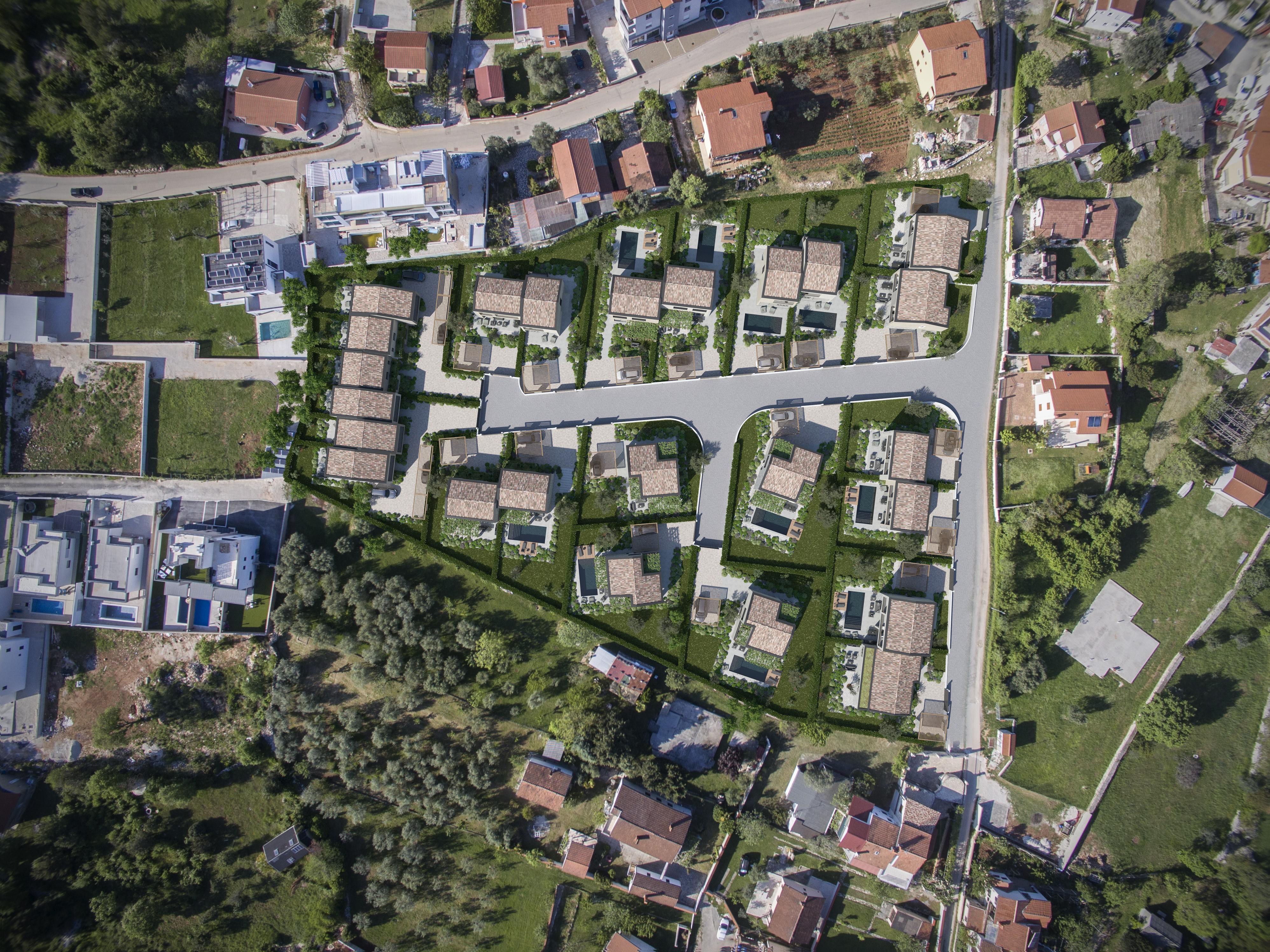
The Second Project in Peroj: Infrastructure First, Architecture as a Guarantee
On a new, larger project in Peroj, we took things a step further.
The investors - an architect and a businessman who understands exactly what holds buyers back - faced the same issue: great location, but no sales for years.
Again, the reason was the same: too many unknowns.
This time we didn’t wait for buyers to ask questions.
We answered them in advance.
Infrastructure was completed and paid for before the first listing:
-
The internal road was asphalted
-
13 kW of electricity capacity was reserved and paid for for every parcel
-
Water was brought to each plot
-
Sewage infrastructure was installed
-
Public lighting was built
When buyers come to see the land, they’re not looking at an empty field full of promises.
They see the road.
They see the connections.
They see a project that is actually being built.
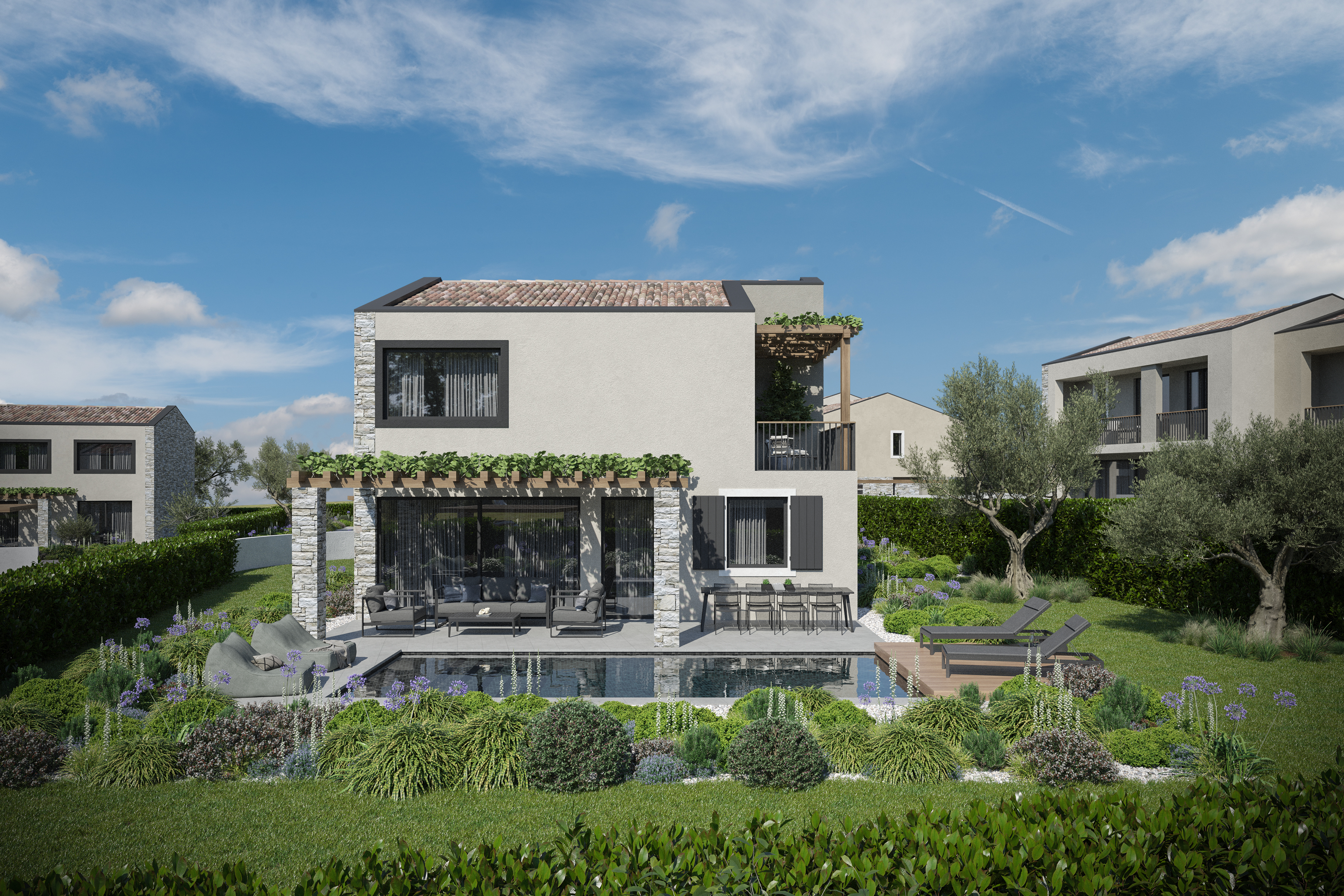
Architecture was defined through a masterplan.
We hired the architectural studio Triptih - Marko Perčić and Danijela Perčić - to create guidelines for the future neighbourhood.
Across the entire project:
-
Flat roofs are prohibited
-
Only pitched roofs in the traditional Istrian style are allowed
-
Parcels cannot be divided into multiple residential units
-
Colours and materials are broadly defined, while still allowing buyers some freedom
All owners sign a co-ownership agreement that regulates everything - from roof types and housing units to maintaining the internal road.
No exceptions. No verbal agreements.
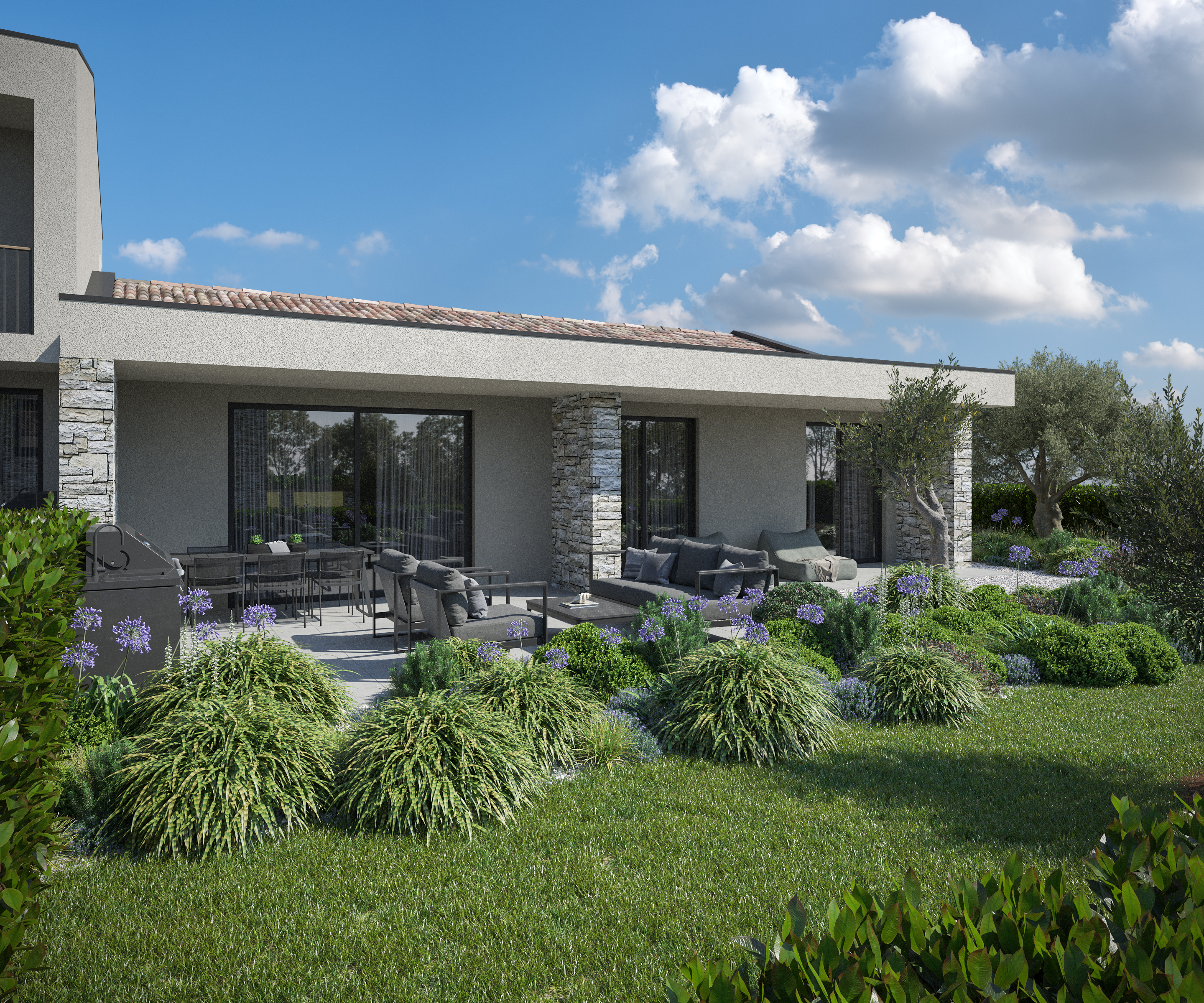
Buyers are free to choose the size of their house, room layout, whether they want a pool or not - all within the framework of the spatial plan and the masterplan.
Why This Model Works - and What It Means for Price
Behind all of this stands a simple idea.
A buyer who knows exactly what they are buying - what will be built around them, what infrastructure awaits them, and what the neighbourhood will look like in ten years - is willing to pay more.
Not because they’re being misled.
But because they’re offered something that almost doesn’t exist on the open market: certainty and predictability.
In an Istria where construction often happened without order or long-term vision, this approach isn’t a revolution.
It’s simply a return to what once made Istria valuable in the first place:
order that protects space - and space that protects value.
A neighbourhood like this is worth more than its surroundings today.
And in ten years, when it’s fully built and the chaos around it becomes even more visible, it will be worth even more.
Silvia from Trieste didn’t get that when she bought her first plot.
But buyers in Peroj will.
Common Questions About Buying Building Land in Istria
How can you know what your neighbour will build?
Short answer: in most cases, you can’t know for sure.
There are a few exceptions. One is when a municipality has well-defined spatial plans with clear rules - Bale is often mentioned as a good example.
The other is when the entire land area belongs to a single investor who sets project rules, records restrictions in the land registry, and obligates future buyers through a co-ownership agreement.
It’s rare - but as we’ve shown here, it pays off financially.
Even then, it’s important to stay realistic. Once someone obtains a usage permit for a residential unit, preventing future changes of use becomes extremely difficult.
In other words: absolute guarantees don’t really exist.
If you are interested in the topic of buying construction land in more depth, watch this video in which I discuss 11 pitfalls to watch out for before buying: Pitfalls when buying construction land
Is infrastructure always solved for building land?
No - and this is one of the biggest risks when buying land.
Water and sewage connections can usually be checked through utility companies and documentation. Electricity is a different story.
Unfortunately, you cannot obtain a written confirmation from HEP about how many kilowatts are available at a location - at least not through an informal request.
HEP won’t provide that information until a full project is submitted for approval. By then you’ve already invested time and money.
In practice, the real capacity is often discovered informally - if you happen to know someone inside the system.
In our Peroj project, the investor managed to reserve the electricity capacity in advance. But that’s the exception, not the rule.
Always ask for written confirmation for water and sewage. For electricity, be realistic: without a project, there’s no precise answer.
Is it worth creating a masterplan if you own a large piece of land?
Yes - for one simple reason: organized projects achieve higher prices.
A masterplan that clearly defines what will be built - construction type, heights, materials, infrastructure - gives buyers certainty.
And certainty has value.
If you own a large undeveloped property you plan to subdivide and sell, a masterplan is not a cost. It’s an investment that directly shows up in the final sales price.
Can you prohibit parcel splitting and building height through contracts?
Yes - but only if the entire land originally belongs to one investor or owner.
In that case, view protection restrictions can be registered in the land registry, and all buyers sign a co-ownership agreement defining construction rules: heights, building types, number of residential units, and maintenance obligations.
If you are buying from a private owner who is selling just a single parcel, this type of protection usually does not exist - and there’s little point in expecting it.
Aljoša Vučetić
Maris Real Estate — Pula, Istria
Looking for building land in southern Istria with clear answers to all the questions above?
Take a look at the currently available plot in Peroj — fully prepared project, complete infrastructure, masterplan in place:
Building Land Peroj, 1,172 m², 800 m from the sea
For anything else, feel free to contact us. Every parcel in our portfolio comes with full documentation and transparent project information.
