Istria Real Estate Market Down 34%: Property Prices, Demand and What to Expect
Author: Aljoša Vučetić, Maris Real Estate | Date: January 2026 | Reading time: 8 minutes
Let’s be honest - numbers don’t lie. Official data from the Croatian Tax Administration have confirmed what many professionals in the field have been sensing for quite some time: the real estate market in Istrian County experienced a dramatic 34% decline between 2023 and 2025. If you are a property owner considering selling, or a potential buyer waiting for the right moment, this analysis is exactly what you need.
Official data leave no room for doubt
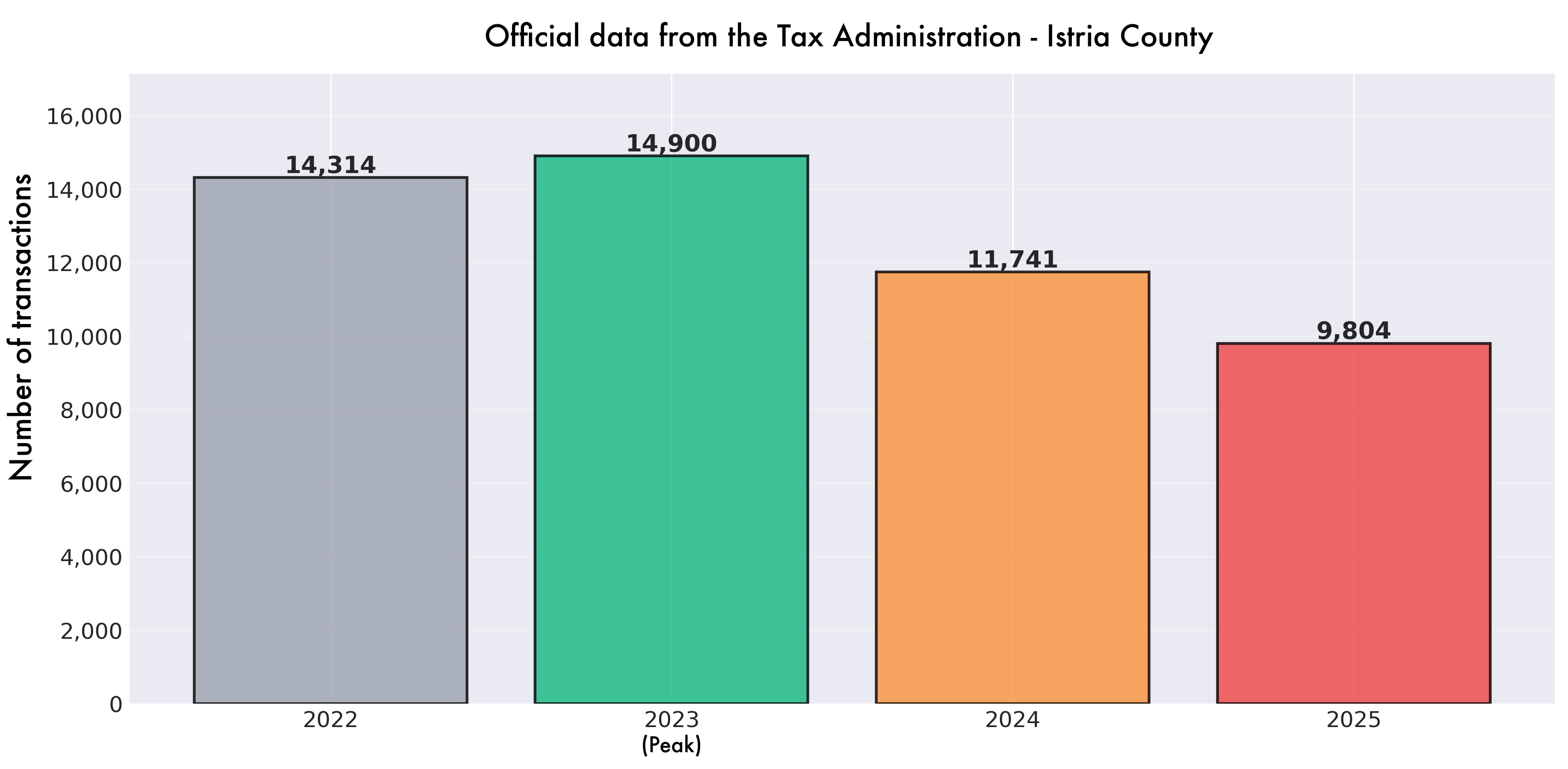
According to the latest official figures from the Croatian Tax Administration, the number of property transactions in Istrian County shows a clear and concerning trend. Let’s take a closer look at what the numbers reveal:
Important note regarding the official data
The official data from the Croatian Tax Administration include ALL types of real estate - apartments, houses, land, commercial properties, garages, and other categories. In our detailed analysis, we focused exclusively on apartments, houses, and building land, as we believe these segments best reflect the true state of the market for the majority of buyers and investors.
Official Croatian Tax Administration Data - Istrian County
What do these numbers mean?
The year 2023 marked the peak of the market, with a record 14,900 transactions. Since then, we have witnessed a continuous decline - first 21% in 2024, followed by an additional 16% in 2025. The total drop from 2023 to 2025 amounts to 5,096 transactions, representing an overall decrease of 34%.
What is happening to sales in southern Istria?
To gain a clearer picture, we analysed data from five key towns in southern Istria: Pula, Medulin, Vodnjan, Ližnjan, and Fažana. We focused on the 2023-2025 period and categorised only apartments, houses, and building land - property types that genuinely reflect the health of the market.
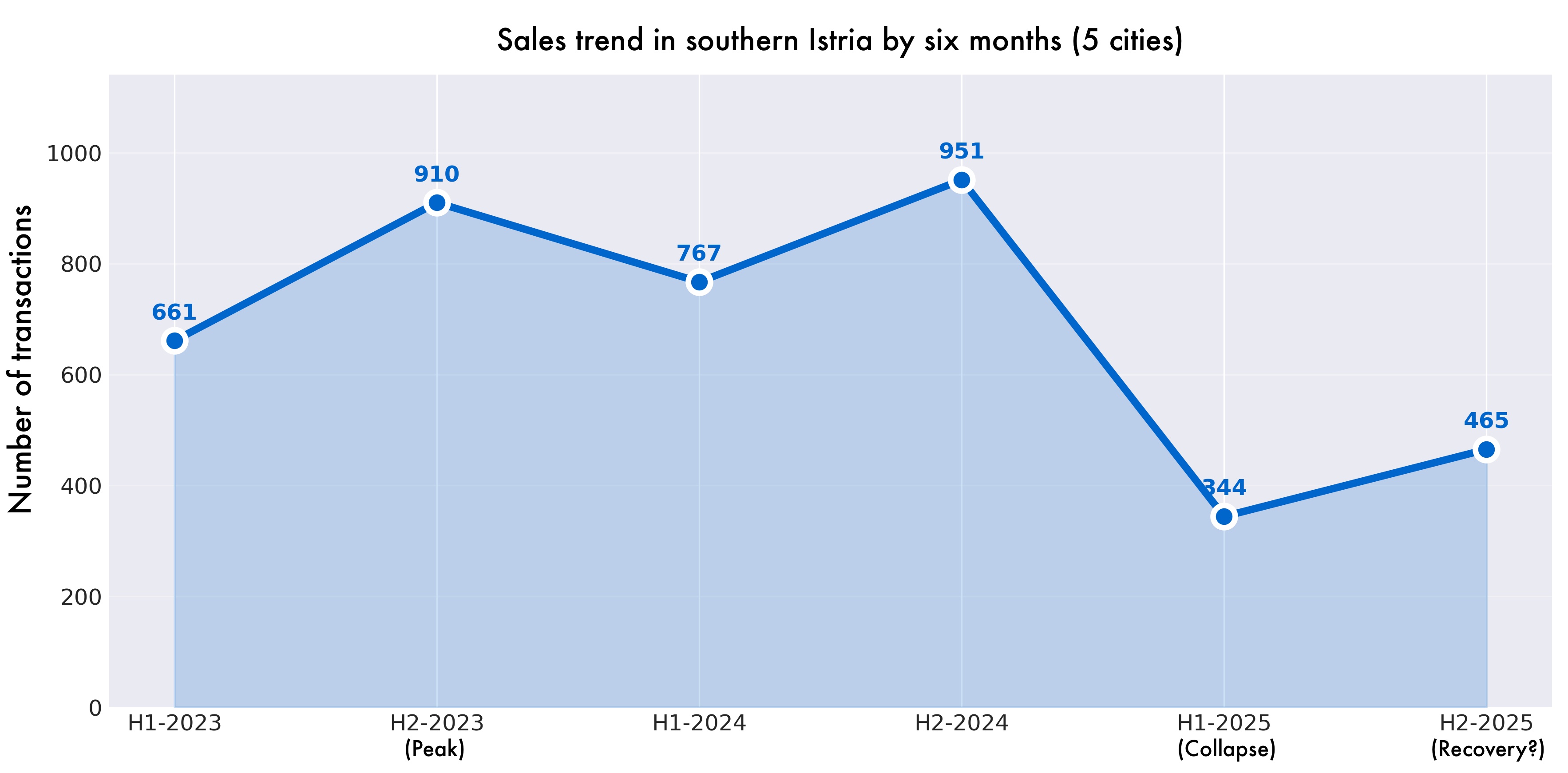
Sales trends in southern Istria by half-year (5 towns)
2025 - The Year of a Major Decline
This chart speaks louder than words. The peak of activity was recorded in the second half of 2023, with 910 transactions. By the second half of 2025, that number had fallen to just 465 transactions - a drop of nearly 49%.
Interestingly, 2024 showed slight growth (+9.4%) compared to 2023, suggesting a delayed impact of broader economic changes. However, 2025 brought a sharp downturn, with activity falling by 52.9% compared to the previous year.
The good news? In the second half of 2025, we can see a modest recovery (+35% compared to the first half of the year). Perhaps the market has reached its bottom.
Pula - €285 Million in Transaction Volume Over Three Years
As the largest city in the region - and the only city whose data have been officially confirmed and aligned with the Croatian Tax Administration - Pula deserves special attention. Between 2023 and 2025, Pula recorded a total of 1,828 property sales, accounting for 44.6% of the combined market across the five analysed towns.
What is even more impressive is the financial volume behind these transactions. When we analyse total turnover in monetary terms, we gain an entirely new perspective. Based on average market prices (apartments ~€182,000, houses ~€320,000, land ~€72,000 per transaction), we estimate that the following volume passed through the Pula market:
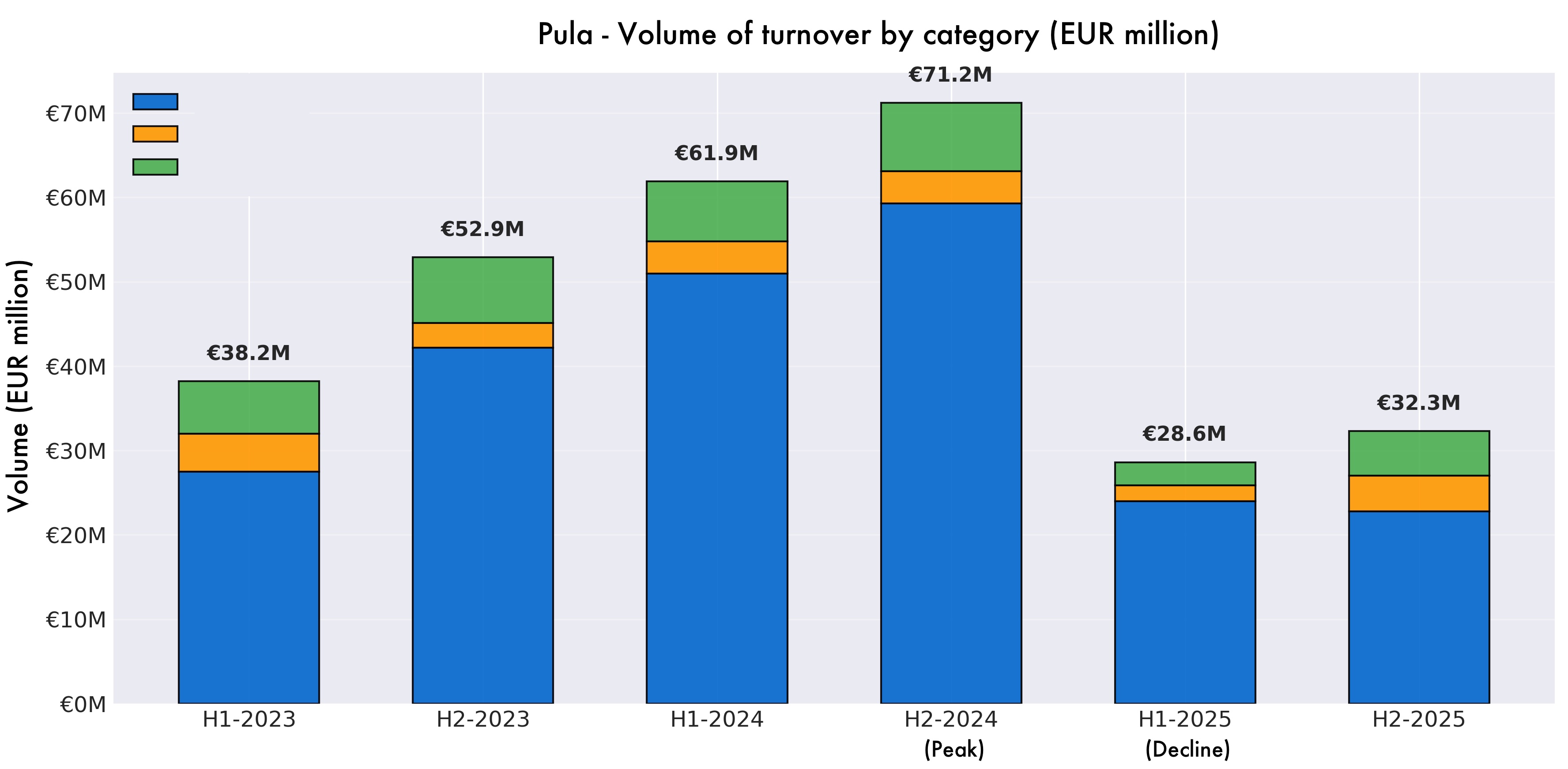
Pula - Transaction Volume by Property Category (€ millions)
Financial Overview of Pula (2023-2025):
Apartments: €226.7 million (79.5% of total transaction volume)
Houses: €21.1 million (7.5% of total volume)
Land: €37.2 million (13% of total volume)
TOTAL: ~€285 million over three years
The peak transaction volume was recorded in the second half of 2024, with an estimated €71.2 million. By the first half of 2025, turnover had dropped to €28.6 million - a decline of nearly 60%. The second half of 2025 brought a slight recovery to €32.3 million, but this remains less than half of the market peak.
Why Is This Decline Happening?
After reviewing the figures, the logical question follows: why? What happened to a market that was at its peak in 2023?
Main Drivers Behind the Market Slowdown:
Interest rates are no longer favourable
An increase in interest rates from around 3% to 3-4% may seem minor, but for the average buyer it significantly reduces borrowing capacity. In addition, banks have become more selective in approving mortgage loans.
Prices have reached their ceiling
After years of continuous growth (2020-2024), property prices have reached levels that many domestic buyers simply cannot afford.
Dominance of domestic buyers purchasing for personal use
A key fact often overlooked is that the majority of buyers are local residents purchasing property to solve their housing needs, not foreign investors. Higher prices, stricter lending conditions, and wage stagnation are making home ownership increasingly difficult for them.
Economic uncertainty
Global inflation and broader economic trends have affected buyer confidence. People are more cautious about making large financial commitments.
What Does This Mean for You? Practical Advice
If you are a buyer:
Now is the time to negotiate. After two years of declining activity, sellers are more realistic and more open to price discussions. The market is no longer a seller’s market as it was in 2023 and early 2024.
Be patient: Do not rush into the first offer you see. There is more choice available than during the “hot” market period.
Do thorough research: Request official valuations and do not rely solely on asking prices. Read our complete buyer’s guide covering every step from property viewings to title registration.
Focus on quality: In this type of market, it is easier to find quality properties at reasonable prices.
Prepare your finances: Although interest rates are around 3-4%, lending criteria are stricter. You will need solid equity and stable income. If you are a foreign buyer or a Croatian living abroad, read our guide to mortgage loans for foreigners
.
Consider smaller properties: Apartments between 40-60 m² and smaller houses offer the best price-to-quality ratio.
If you are a seller:
Realism is key to a successful sale. The time of quick sales at inflated prices is over. The 2026 market requires a different approach.
Accurate valuation is essential: Engage a certified valuer. Overpriced properties remain on the market for months.
Check your documentation: Before listing your property, ensure you have a valid occupancy permit
or begin the process of obtaining one. Without it, banks will not approve financing for the buyer.
Analyse the competition: Review what is currently listed in your street and neighbourhood. Who are your competitors? How similar are their properties and at what prices are they advertised?
Be prepared to negotiate: Flexibility speeds up the sale.
Marketing is crucial after valuation: Professional photography, video, virtual tours, and floor plans are now standard. But that is not all - paid advertising is a must-have, not a luxury. Without visibility, there is no sale.
Track and analyse performance: Monitor your listings, calls, and enquiries. If there is no response within 2-3 weeks, do not wait - react quickly and adjust the price or marketing strategy.
Remember: Selling property is not a promise, but an active process. It requires your engagement and willingness to adapt.
Timing matters: The second half of the year usually shows stronger activity.
If you are an investor:
The long-term outlook remains positive. The current market correction presents opportunities for strategic acquisitions.
Pula as a safe choice: As the regional centre, Pula offers the strongest long-term prospects.
Building land with permits: Developing at current construction costs can be profitable.
Smaller apartments in tourist locations: Stable rental demand and lower entry prices. Planning short-term rentals? Read our guide to renting apartments and holiday homes, including 2026 regulations.
Development of smaller family houses: In Pula and the surrounding area, there is currently little competition in the segment of smaller, high-quality family homes (100-150 m²). Market demand exists, while supply remains limited. Consider this opportunity seriously or explore our current selection of houses for sale in Istria
.
Avoid overpriced properties: It is better to wait for a correction than to buy at the peak.
Conclusion: The Market Is Adjusting to a New Reality
A 34% decline in Istrian County is not a reason for panic, but a natural correction after years of overheating. 2023 was a golden year that will not be repeated soon, but this does not mean that property in Istria has lost its value or appeal.
What has changed is the approach. The era of selling everything regardless of price or quality is over. Buyers now demand real value for money, and sellers must be more realistic in their expectations.
For those who approach the market with a clear strategy, reliable data, and realistic expectations - whether buying or selling - 2026 can be a very successful year. Need professional advice or a property valuation? Contact us
for a free consultation.
Planning to buy or sell property in Istria?
With over 20 years of experience in the southern Istria market, the Maris Real Estate team can help you make the right decision - whether you are searching for the perfect property or looking to sell at the optimal price.
Contact us directly via WhatsApp and let’s discuss your needs.
Aljoša Vučetić is the Director of Maris Real Estate, an agency specialised in the southern Istria property market. With more than 20 years of experience, Aljoša and his team provide expert guidance in property purchases, sales, and investments throughout the Pula region.
 +385 52 501 333
 info@maris.hr